The Future of Crushing & Screening: What Will the Industry Look Like in Five Years?
Anticipating what the industry will look like in the near futureThe crushing and screening industry has always been driven by one fundamental requirement: producing the right material, at the required specification, at a cost that makes commercial sense.
What is changing is how we achieve that objective.
Over the next five years, crushing and screening is likely to become increasingly mobile, connected, energy-conscious and application-specific. Equipment will continue to become more sophisticated, but the biggest shift may be less about individual machines and more about how entire processing circuits are designed, monitored and operated.
Cost per tonne will become more important than machine size
For many years, equipment selection has often focused heavily on production capacity. A machine capable of producing a higher number of tonnes per hour can appear to offer the obvious advantage. However, maximum production does not necessarily mean the lowest cost per saleable tonne. Fuel or electricity consumption, wear rates, maintenance, downtime, utilisation, screening efficiency and material handling can have a significant impact on the actual economics of a crushing operation.
Recent industry commentary in South Africa reflects this changing approach, with greater attention placed on total operating cost, productivity and the contribution equipment makes to the cost of producing a saleable tonne. The biggest crusher will not necessarily be the best crusher. A plant that is correctly matched to the feed material, required products and production target may deliver a better commercial result than a larger machine operating below its potential. Screening will also play an increasingly important role. Removing material that does not need to be crushed before it reaches the crusher can reduce unnecessary wear, energy consumption and processing costs.
The result is a broader understanding of efficiency: not simply how many tonnes a machine can process, but how efficiently the entire circuit converts feed material into saleable product.
Mobile crushing will move closer to the material
The continued development of mobile crushing and screening equipment is likely to be one of the most significant trends of the next five years. The principle is simple: process material where it makes the most commercial sense.
Instead of transporting large quantities of raw material to a distant fixed processing facility, mobile equipment can bring the processing capability to the project. This can be particularly valuable on infrastructure, mining and renewable-energy projects where material may be available on or close to the project site. Reducing unnecessary movement of material can mean fewer haulage requirements, less double handling and potentially lower project costs. Mobile equipment can also be relocated as a project progresses, allowing the processing solution to adapt to changing site conditions.
For Eco-Match, this is already a fundamental part of how we approach crushing and screening. By taking the processing plant directly to the material, rather than treating mobile equipment simply as a smaller version of a fixed plant, the focus shifts towards on-site production, reduced material handling and a solution that can adapt to the requirements of the project.
The market is already moving in this direction. Recent developments in Southern Africa include high-capacity mobile crushing systems designed specifically to provide greater production capability while reducing the infrastructure and deployment requirements traditionally associated with large fixed plants.
Crushing equipment will become increasingly connected
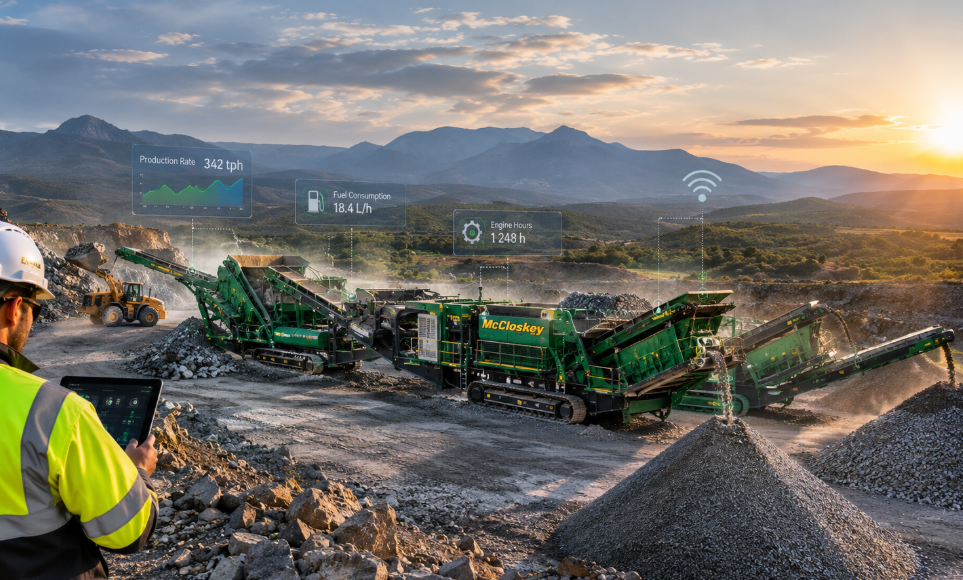
One of the biggest changes may be something that is less visible than a new crusher design: the amount of information equipment can provide. Connected equipment and telematics are already allowing operators and equipment owners to monitor production, operating hours, fuel consumption, machine performance and maintenance requirements.
Eco-Match is already using telematics across its fleet, giving the team access to valuable operational information that can be used to monitor equipment performance, track operating hours and support maintenance planning. This provides a practical example of how digital technology is becoming part of day-to-day crushing and screening operations, rather than simply being a future concept.
Instead of waiting for a machine to develop a problem, operators will increasingly use machine data to identify developing issues and plan maintenance before an unexpected failure occurs. When a mobile plant is operating on a remote project, an unplanned breakdown can have consequences far beyond the cost of repairing a component. It can interrupt production, affect downstream operations, delay project programmes and leave labour and other equipment underutilised.
Predictive maintenance and real-time monitoring therefore have the potential to become valuable production tools rather than simply technology features. Over time, the question may no longer be whether a machine is connected, but how effectively it uses the information it generates.
What about the people?
Technology will change the crushing and screening industry, but it will not remove the importance of skilled people. A sophisticated machine still needs to be correctly set up, operated, maintained and monitored. In fact, as equipment becomes more advanced, the knowledge required to get the best from it may become even more important.
At Eco-Match, our approach has always recognised that the performance of a crushing and screening circuit depends on more than the machines themselves. Experienced operators need to understand the material being processed, recognise changes in plant performance and make adjustments to keep production moving efficiently.
As equipment becomes increasingly automated and connected, the role of the operator is likely to evolve. Rather than simply controlling a machine, operators will increasingly be expected to understand the complete processing circuit, interpret machine data, identify potential issues and make informed decisions that affect production, product quality and equipment utilisation. This places greater value on multi-skilled, experienced teams who understand both the equipment and the practical realities of operating on site.
For mobile crushing and screening operations in particular, people remain critical. Conditions can change quickly, whether because of variations in feed material, changing weather, site access, production requirements or the condition of the material being processed. Technology can provide information, but it is still people who interpret that information and decide what action is required.
What won’t change
Despite all the developments expected over the next five years, some fundamentals will remain the same. Good crushing starts with understanding the material. The feed size, rock characteristics, abrasiveness, moisture content and required final products will continue to determine how a circuit should be configured. Good screening will remain essential. Preventative maintenance will remain essential. Reliable equipment will remain essential. And experienced people will remain essential.
Frequently asked questions
How is technology changing crushing and screening?
Connected equipment and telematics are making it possible to monitor factors such as operating hours, production, fuel consumption, machine performance and maintenance requirements. This information can support more proactive maintenance, improve equipment utilisation and help operators make better production decisions.
Will automation replace crushing and screening operators?
No. While automation and digital technology will change the role of operators, experienced people will remain essential. Modern crushing and screening requires people who can understand material characteristics, monitor the complete circuit, interpret equipment data and respond to changing site conditions. As equipment becomes more sophisticated, skilled and adaptable operators are likely to become even more valuable.
What is the future of crushing and screening?
The future of crushing and screening is likely to focus increasingly on mobility, efficiency, digitalisation, electrification and application-specific equipment. Rather than simply selecting the largest available machine, operators and contractors will place greater emphasis on total cost per tonne, equipment utilisation, uptime and the performance of the complete crushing and screening circuit.